Living with Uncertainty
What neurobiology teaches us about how our brains process uncertainty and how we can learn to navigate life without all the answers.
In 1935, physicist Erwin Schrödinger proposed a thought experiment: a cat in a sealed box exists in a state where it is both alive and dead until someone opens the box to observe it.[5] He wanted to illustrate how absurd quantum mechanics seemed when applied to everyday objects. But what Schrödinger perhaps did not anticipate was how perfectly his hypothetical cat would describe the human experience of uncertainty. We spend our lives standing in front of closed boxes, desperate to know what is inside, paralyzed by the possibility that it could be anything at all.
Why uncertainty hurts more than bad news
A few years ago, researchers at University College London conducted an experiment that changed how we understand stress.[1],[11] They recruited 45 participants and placed them in a situation that sounds almost comically simple: they would see an image on a screen and sometimes receive a small electric shock. Nothing dangerous, but certainly unpleasant.
Here is what made the study fascinating. Sometimes participants knew for certain they would receive the shock. Sometimes they knew for certain they would not. And sometimes the probability was fifty-fifty, a coin flip. The researchers measured everything: cortisol in saliva, pupil dilation, skin conductance and subjective reports of stress.
The results were counterintuitive. The most stressed participants were not the ones who knew pain was coming, but rather the ones who did not know. When the probability of receiving a shock was 50%, participants sweated more, their pupils dilated more dramatically and their cortisol levels spiked higher than when they were guaranteed to feel pain.
Think about that for a moment. We would rather know that something bad is going to happen than live with the possibility that it might not happen at all. The uncertainty itself is the wound.
The brain’s prediction machine
To understand why uncertainty affects us so viscerally, we need to look inside the brain. Your mind is not a passive observer of reality, but rather a prediction machine, constantly generating hypotheses about what will happen next and comparing those predictions against incoming sensory data.
A 2025 systematic review on the neurobiology of intolerance of uncertainty revealed that when people with high uncertainty intolerance face ambiguous information, three specific brain regions light up with unusual intensity.[4] The amygdala, our ancient threat detection center, sounds the alarm. The anterior insula, responsible for predicting how we will feel in future scenarios, begins running simulation after simulation. And the anterior cingulate cortex, which monitors conflict and alertness, goes into overdrive.
Meanwhile, the prefrontal cortex, the rational part of our brain that should help regulate these alarm signals, shows reduced activity. It is as if uncertainty presses the accelerator on our anxiety while simultaneously cutting the brake lines.
The insula deserves special attention here. This region connects our bodily sensations with our predictions about the future. When you face uncertainty, your insula starts generating scenarios, projecting how you would feel if this happened, or if that happened instead. And here is the remarkable part: your body responds to these imagined futures as if they were actually happening. This is why uncertainty makes your stomach hurt, why your chest feels tight when you are waiting for test results. Your brain is not distinguishing between imagined pain and real pain because, to your nervous system, there is no difference.
The cat, the box and the act of looking
Let us return to Schrödinger’s cat. In quantum mechanics, a particle exists in a superposition of states until it is measured. The act of observation collapses the wave function and forces the particle to choose one state or another. Schrödinger found this idea ridiculous when applied to macroscopic objects like cats: how could a cat be simultaneously alive and dead?
But ridiculous or not, something similar happens in our lives. When you are waiting for medical test results, you exist in a kind of superposition where you are both healthy and sick. When you are waiting to hear whether you got the job, you are both employed and rejected. The moment you receive the information, all those possibilities collapse into one reality.
What Schrödinger’s thought experiment reveals is that uncertainty is not a flaw in the system, but rather fundamental to how reality works at the deepest level. Werner Heisenberg formalized this in his uncertainty principle: there are limits to what we can know simultaneously about any system.[6],[12] The more precisely we know one property, the less precisely we can know another. At the quantum level, uncertainty is not caused by imperfect instruments or incomplete information, but rather woven into the fabric of existence itself.
Perhaps the universe is trying to tell us something.
The two faces of intolerance
Psychologist Nicholas Carleton has spent two decades studying what he calls intolerance of uncertainty, and he proposes a provocative idea with substantial empirical support: fear of the unknown may not be just one fear among many, but rather the fundamental fear, the ancient root from which all other fears grow.[2],[3]
Consider your own fears for a moment. Are you afraid of public speaking? At its core, that is a fear of not knowing how the audience will react. Afraid of flying? You do not know if something will go wrong. Afraid of falling in love again? You do not know how this story will end (guilty). Almost every fear, when you trace it back far enough, leads to the same source: you do not know what will happen.
This intolerance manifests in two distinct patterns. The first is prospective intolerance, an intense desire to predict, anticipate and plan everything. People dominated by this pattern make lists. They research exhaustively before any decision. They read every review before buying a piece of furniture. They want to see the whole map before taking a single step because they cannot bear the thought of making a wrong turn.
The second pattern is inhibitory intolerance: when facing uncertainty, the person freezes. They cannot decide, cannot act, cannot move. They procrastinate, avoid and wait for clarity that never comes. “I want to start a business,” they might say, but then spend years turning the idea over in their mind without ever taking action.
Many people experience both patterns simultaneously. They research obsessively, gathering information from every possible source, and then when they have accumulated enough data to fill a library, they look at it all and think: I still do not know what to do. The research itself becomes a form of procrastination, a way to feel productive while actually delaying the moment of decision.
The case for uncertainty
Before we rush to cure ourselves of this discomfort, we should ask whether intolerance of uncertainty is always a problem to be solved.
Consider the surgeon who triple-checks before making an incision. The engineer who runs one more simulation before approving the bridge design. The researcher who demands more data before publishing a conclusion. In these contexts, discomfort with uncertainty is not a disorder, but rather professional rigor. It is the difference between careful and careless.
Research on creativity and entrepreneurship reveals something counterintuitive: tolerance for uncertainty predicts innovation and entrepreneurial success. People who can sit with ambiguity, who can act without complete information, who treat the unknown as possibility rather than threat, are more likely to start companies, generate novel ideas and adapt to changing circumstances. A 2025 study in Current Psychology found that uncertainty tolerance has a positive impact on entrepreneurial behavior tendency, with radical innovation playing a mediating role.[19] Uncertainty tolerance does not just reduce anxiety, but also enables creation.
This suggests that our goal should not be to eliminate discomfort with uncertainty but to develop flexibility: the capacity to tolerate uncertainty when certainty is impossible while still pursuing it when it matters. The question is not “How do I stop caring about not knowing?” but rather “Is this a situation where more information would help, or am I seeking certainty as a way to avoid action?”
The answer changes depending on context. Checking reviews before buying a car is reasonable. Checking reviews before choosing a restaurant for the fourteenth time is avoidance wearing the costume of research.
Why our generation feels this more acutely
If uncertainty has always been part of the human condition, why does it seem to affect us so intensely now?
The pandemic exposed something that was already there. Anxiety levels in young adults rose sharply during COVID-19 and, unlike in older adults, never returned to baseline.[10]
Psychologist Jeffrey Arnett identified five defining features of emerging adulthood: identity exploration, instability, self-focus, feeling in-between and a sense of abundant possibilities.[9] Notice how four of those five are euphemisms for uncertainty. You are exploring because you have not found. You feel in-between because you have not arrived. You see possibilities because nothing has been decided.
Previous generations navigated this developmental stage with clearer scripts. By thirty, you were supposed to be married, employed, settled (sometimes I catch myself wishing I could skip ahead to that part, just to remove the uncertainty). The uncertainty existed, but it was bounded by social expectations that narrowed the field of possibilities. Today, the options are infinite. You can live anywhere, work remotely, change careers at forty, have children at forty-five or never. And with infinite options comes infinite uncertainty about which path to choose.
When you have more options than you can possibly evaluate, choosing one means giving up all the others. And because you cannot know which option would have been best, you remain frozen at the crossroads, staring at doors you are afraid to open.
Learning to live in the rain
So what do we do with all of this? How do we function in a world where uncertainty is not a bug but a feature?
The answer is not to eliminate uncertainty, because that is impossible. The answer is to change our relationship with not knowing.
But here is where I must complicate the story I have been telling. Intolerance of uncertainty is not purely maladaptive. From an evolutionary perspective, our ancestors who paused at ambiguous rustling in the grass survived to reproduce. Those who needed certainty before fleeing did not. Risk aversion became the dominant behavior in small populations,[18] precisely the kind of groups humans lived in for most of our history. Your brain treats uncertainty like danger because, for most of human existence, uncertainty often was danger.
The problem is not that we dislike uncertainty, but rather that our ancient threat-detection system cannot distinguish between a predator in the bushes and an unanswered text message. Both trigger the same neural alarm.
Think of it like rain. You cannot control whether it rains. You can shake your fist at the sky, you can curse the clouds, you can refuse to leave the house until the sun returns. Or you can grab an umbrella and go about your day. The rain continues, but your life continues too.
The first step is distinguishing between uncertainty and danger. Your brain has a tendency to translate “I don’t know” into “something bad will happen.” But these are not the same thing. If you have seen He’s Just Not That Into You, you know this scene: the protagonist goes on a date where everything seems to go well. She waits for the call. Days pass. Nothing. Faced with an uncertain future, she invents scenario after scenario to explain why they did not call. Maybe he lost her number. Maybe he is busy. Maybe he is dead. The uncertainty becomes unbearable, so her mind fills the void with stories, each more elaborate than the last.
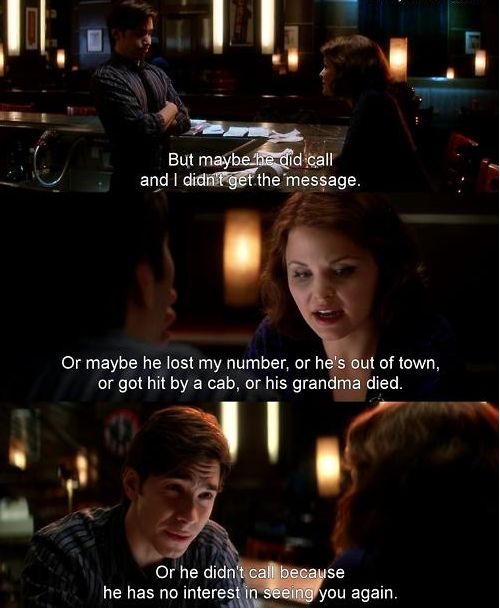 That is catastrophizing. Assuming the worst is your amygdala hijacking the narrative.
A practical exercise: when you notice anxiety rising around an unknown, ask yourself three questions. What do I actually know for certain right now? What do I not know? Which parts of what I do not know am I treating as threats when they are simply gaps in information?
This is not about positive thinking, but rather about accurate thinking.
Radical acceptance of the unfinished story
There is a concept in psychology called radical acceptance. It does not mean liking what is happening or resigning yourself to a bad situation, but rather allowing reality to be what it is without exhausting yourself in the fight against it.
When the feeling of not knowing arrives, instead of immediately reaching for your phone to research, instead of asking everyone you know for their opinion, instead of running through worst-case scenarios in your mind, try saying to yourself: I do not know, and it is okay not to know. This is uncomfortable, but nothing bad is happening to me in this moment. I do not have to know everything all the time.
The question to ask yourself is not “What is the correct answer?” but “How do I want to live, knowing that every path leads through uncertainty?”
The box is already open
Schrödinger’s cat is a thought experiment, but life is not. In life, there is no waiting outside the box, because you are already inside it. The superposition has already collapsed. Every moment, reality is becoming something specific, and you are part of what determines its shape.
The uncertainty will never disappear. The boxes will remain closed until you open them. But you do not need certainty to take the next step. You only need to accept that the next step is possible without it.
And embrace it.
And perhaps that is the deepest lesson quantum physics has for us. At the foundation of reality, uncertainty is not a problem to be solved, but simply how things are. The particles do not seem to mind. Maybe we can learn something from them.
I want you to know that whatever box you are standing in front of right now, whatever question is keeping you awake at night, you are not alone in that discomfort. Every person you admire has stood where you are standing, paralyzed by the same fear of not knowing. The difference is that at some point, they decided that living with uncertainty was better than waiting for a certainty that would never come. You can make that same choice. Not because it is easy, but because the alternative, remaining frozen at the threshold of your own life, is far more painful than any answer you might find inside the box.
References
de Berker, A. O., Rutledge, R. B., Mathys, C., Marshall, L., Cross, G. F., Dolan, R. J. & Bestmann, S. (2016). Computations of uncertainty mediate acute stress responses in humans. Nature Communications, 7, 10996. https://doi.org/10.1038/ncomms10996
Carleton, R. N. (2016). Into the unknown: A review and synthesis of contemporary models involving uncertainty. Journal of Anxiety Disorders, 39, 30–43. https://doi.org/10.1016/j.janxdis.2016.02.007
Carleton, R. N. (2012). The intolerance of uncertainty construct in the context of anxiety disorders: Theoretical and practical perspectives. Expert Review of Neurotherapeutics, 12(8), 937–947. https://doi.org/10.1586/ern.12.82
Grupe, D. W. & Nitschke, J. B. (2013). Uncertainty and anticipation in anxiety: An integrated neurobiological and psychological perspective. Nature Reviews Neuroscience, 14(7), 488–501. https://doi.org/10.1038/nrn3524
Schrödinger, E. (1935). Die gegenwärtige Situation in der Quantenmechanik. Naturwissenschaften, 23(48), 807–812.
Heisenberg, W. (1927). Über den anschaulichen Inhalt der quantentheoretischen Kinematik und Mechanik. Zeitschrift für Physik, 43(3–4), 172–198.
Arnett, J. J. (2004). Emerging adulthood: The winding road from the late teens through the twenties. Oxford University Press.
Schweizer, S. (2023). Uncertainty as an engine of youth mental health crisis. Current Opinion in Psychology, 52, 101619. https://doi.org/10.1016/j.copsyc.2023.101619
University College London. (2016, March 29). Uncertainty can cause more stress than inevitable pain. UCL News. https://www.ucl.ac.uk/news/2016/mar/uncertainty-can-cause-more-stress-inevitable-pain
Hilgevoord, J. & Uffink, J. (2024). The uncertainty principle. In E. N. Zalta (Ed.), The Stanford Encyclopedia of Philosophy. https://plato.stanford.edu/entries/qt-uncertainty/
Hintze, A., Olson, R. S., Adami, C. & Hertwig, R. (2015). Risk sensitivity as an evolutionary adaptation. Scientific Reports, 5, 8242. https://doi.org/10.1038/srep08242
Zhang, Y., Wang, X. & Liu, Y. (2025). Uncertainty tolerance and entrepreneurial behavior tendency: The mediating role of radical innovation. Current Psychology. https://doi.org/10.1007/s12144-025-08428-0